How Australians spend their 24 hours — work, care and free time across life stages
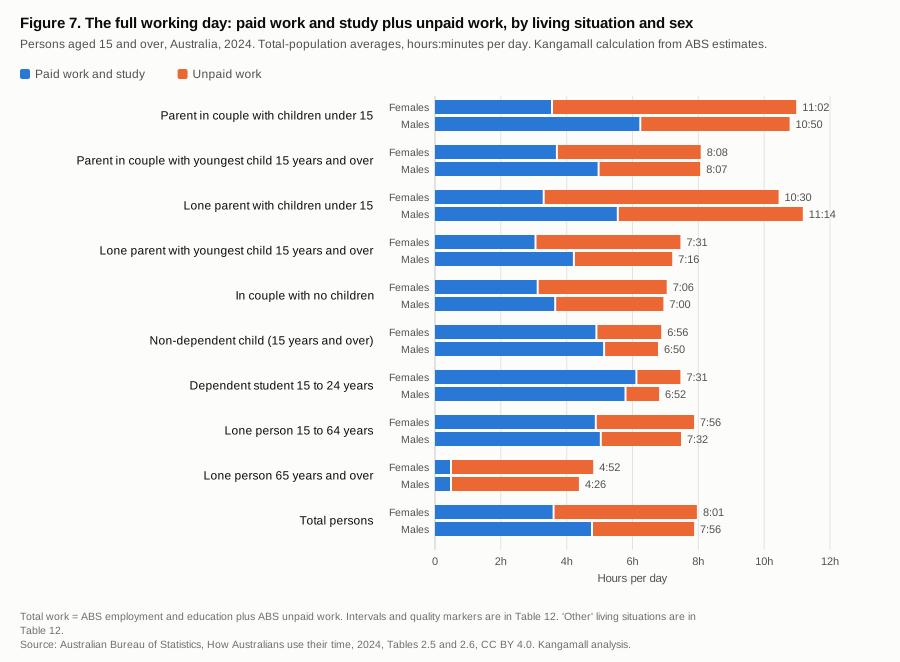
Counting unpaid work, Australian females and males work about eight hours a day, but in a very different mix. Life stage, care and time pressure from the ABS 2024 Time Use Survey, with seven charts, 12 tables and every number traced to its source.
Published reports appear above. The agenda below is clearly marked as in progress, planned or deferred. These research questions are not published findings.
FIVE QUESTIONS BEHIND A CHOICE
More than the price.
01
Money
What will it cost, including the extras?
02
Time
How much searching, waiting and organising is involved?
03
Quality
What evidence helps us judge whether it is suitable?
04
Access
Is it available where and when it is needed?
05
Certainty
What is included, and what happens if plans change?
THE WHOLE OF EVERYDAY LIFE
Our field of view.
From a first home to supporting a parent, our questions follow people through different places, households and stages of life. These are research areas, not completed report collections.
01
Home & renting
Housing, moving, maintenance, gardens and the practical work of running a home.
02
Education & learning
Childcare, after-school care, tutoring and learning at different stages of life.
03
Health & care
Access, waiting, published costs and the information people need to navigate services.
04
Shopping & spending
How people compare value, shop, repair, reuse and manage recurring costs.
05
Work & skills
Changing work, AI, retraining and the balance between earning and everyday life.
06
Transport & mobility
Commuting, car ownership, maintenance and getting around locally.
07
Travel & leisure
Australian travel choices, holidays, recreation and the time and money behind them.
08
Family & life stages
Living alone, raising children, pets, supporting parents and retirement.
09
Community & place
Local facilities, accessibility and differences between metropolitan and regional life.
THE RESEARCH AGENDA
What we’re investigating next.
We aim to publish research fortnightly as evidence and review allow. Each study will have a defined scope, a visible method and sources you can follow. Topics may narrow as we assess the available evidence.
01Published
Households & everyday life
Australian Time Use Report 2026
How are paid work, housework, care and free time shared across life stages, and who feels pressed for time?
Approach
Analysis of all 25,110 values published from the ABS 2024 Time Use Survey, with ABS error measures and significance tests.
What it offers
Charts and tables on time allocation, care and time pressure, with every number traced to its ABS source cell.
Can a customer understand the scope, total price and conditions before making contact?
Proposed approach
A documented sample of public service pages in selected locations and categories. It will not be a national industry census.
What it could help you do
A comparison framework for service scope, inclusions and extra charges.
03Planned study
Shopping & spending
What does a purchase cost after checkout?
How do delivery, installation, upkeep and return conditions change the comparison?
Proposed approach
Clearly defined purchasing scenarios, with dated prices and terms compared on a consistent basis.
What it could help you do
A total-cost checklist with transparent assumptions.
04Planned study
Education & learning
What helps families compare learning and care?
How do fees, schedules and available quality information shape a family's options?
Proposed approach
A focused study of one service type, with geography and scope defined before collecting information.
What it could help you do
Questions families can use to compare suitable options.
05Planned study
Health & care
What gets in the way of accessing healthcare?
What can official evidence tell us about cost, waiting and access to services?
Proposed approach
Analysis of official patient experience statistics, separating different barriers and population groups.
What it could help you do
An evidence-led explainer and appointment information checklist, not treatment advice.
06Planned study
Travel & leisure
How are Australians' overseas travel choices changing?
What changes when we distinguish destinations, travel purposes and seasons?
Proposed approach
Comparable official travel data, distinguishing trips from people and observed travel from stated preferences.
What it could help you do
A sourced view of travel patterns, without assuming why each person travelled.
CLEAR ABOUT WHAT WE KNOW
Evidence you can follow.
A useful report explains its sources, its method and its limits. We distinguish public data analysis, sampled observations and first-hand research, and identify commercial relationships when they exist.